Chapter 17: The Stool
The old man carried the candlesticks up onto the stage.
While he set one at each chalk mark, I sat on the stool and looked over the paper. Each time he placed one, he raised a hand without looking my way. A raised hand meant it was correctly positioned, so I marked it on the paper.
The last candlestick stood at the second mark from the right. Half a step inward.
The old man came down from the stage and stood beside the stool.
"That’s all of them."
"Yes. None of them shifted."
"You stay here today. Don’t lift your head. Just do your job."
The old man dragged over an empty crate and sat down beside the stool. On performance days, he was the one who received crates from the darkness on the other side of the stage. Today he sat here instead, without saying why.
His hands, resting on his knees, were empty. It was rare to see the old man’s hands in the theater without a rag in them, and they looked like hands that did not know where they belonged.
The lamps onstage were lit one by one.
The candles in the candlesticks were lit as well, little flames standing at every chalk mark. Beyond that light, the audience seats were darkness, their rows faintly sunken into it.
As the afternoon waned, the corridor grew quiet.
The footsteps that had filled the place since morning abruptly stopped at some point, and I sensed the chorus performers lining up in the darkness behind the stage. Their clothes brushed together, but there were no voices.
Even Vodianitsa’s quick, light footsteps blended into them, impossible to pick out.
The theater manager passed through the corridor toward the front entrance. The hand adjusting his glasses was slower than usual, and no one passed through the corridor after him.
A sound came from the front entrance.
On a performance day, this was when the bell would ring. Today, instead of a bell, the sound of a heavy door scraping open across stone traveled down the long corridor to the back of the stage. Then came the theater manager’s voice.
He was too far away for me to make out the words. I could only tell that he was speaking far more quietly and slowly than usual.
I could not hear anyone answer him.
Footsteps entered the audience hall.
There were perhaps three, not many. Of the sounds crossing from the stone floor to the wooden floor, one set was even and steady, while two followed before and behind it.
I lifted my head.
My eyes moved before I could remember being told not to. Three human shapes entered the darkness beyond the stage lights, then stopped at the center row.
Something gleamed.
Silver flashed once above the head of the person standing before the middle seat. Before I could tell whether the stage candles had reached that far or whether it had shone on its own, the light went out.
For some reason, my shoulders hunched. Only one person was about to sit in the center of the audience, yet it felt as though the entire theater leaned toward them.
White fabric rustled aside.
When that person sat, the darkness swallowed the seat again. The two figures standing to either side did not sit, and they were no more than silhouettes in the dark.
The two standing figures leaned half a step toward the seated person. It was the posture of guards, and from the darkness behind the stage came the sound of someone drawing their coat closed.
The old man’s hand came down on my knee.
"Your job."
At the low voice, I lowered my eyes. Under the flickering candlelight, the marks on the paper looked doubled.
The theater grew cold.
The front door was still open, and outside air seemed to be traveling through the corridor all the way to the side of the stage. Watching the stage candles tilt to one side and right themselves, I turned up my collar.
The theater manager’s voice came from the audience. This time I could hear him, because he was speaking toward the stage.
"We will begin."
I could not tell whose words he was relaying. If someone in the middle of the audience had said something to him, those words had not reached the side of the stage. Only the manager had received them and passed them on to the stage.
The piano sounded first.
The piano I heard every day in the rehearsal room sounded like another instrument onstage. The theater was as vast as the time it took for the sound to rise to the round roof and descend again.
There were three singers.
The first was one of the principals. She was the person who sang alone in the center of the stage on performance days, and her voice was the same as it had been then.
There was nothing else to say about it, even from the stool. A good singer sang well, and until her song ended, the darkness of the audience did not move once.
Of the two people who had written their names neatly on the list, I could not tell from the stool which was the niece of which household. That was not something singing could reveal, and if it could have been, there would have been no need for an audition.
The second was also a principal. She sang longer than the first, sustaining her notes for longer, then wavered at the end.
Not a sound came from the audience. Perhaps the singer knew it too, because her steps as she went backstage were quicker than when she had emerged.
There was no applause.
I could not tell from the stool whether that was because this was an audition rather than a performance, or because no one dared applaud when the guest did not. Perhaps the fact that nothing came from the middle of the audience was the answer of this place.
After the second singer went in and the piano paused, someone behind the stage took a deep breath and let it out. It was the darkness where the chorus performers stood in a line, and I did not know whose breath it was.
The third singer came out.
A person with cloth wrapped around her head walked to center stage. Her steps were slower than usual, and after taking those slow steps, she stood beside the piano and looked toward the audience.
Once she had stopped, her hand went to the edge of the cloth. It was a habitual gesture, but rather than fixing it, she merely touched the edge and lowered her hand.
The name scrawled crookedly at the bottom of the audition list stood last onstage. The person who always complained about being at the very end of the rehearsal order was at the very end today, in the place that would remain in the ear the longest.
The piano began again.
The song started. Its first line lingered low.
It trembled.
Her voice was not one that should tremble in the low passage. I had heard that song six times in the props room and through the wall every morning, yet in the middle of the first line, it cracked thinly.
Vodianitsa was looking toward the center of the audience. She had said that from the stage, all one could see were human shapes and something shining in the audience. What had entered her eyes must have been that gleam.
Nothing came from the silver. Darkness remained darkness, and while she looked at it, her voice shook.
Then her eyes came to me.
They left the middle of the audience, crossed to the darkness beside the stage, and reached me. Her eyes held the words she had once said: Even if the stool is dark, I can see your face.
I nodded.
There was no score, and it was not yet time for my eyebrows to move. As in the props room, I only nodded once, though I did not know whether she could see it in the dark.
The person who had survived after hearing this voice in a snowfield was sitting on a stool. That voice was shaking now, not in a snowfield but on a stage, and all the person on the stool could do was nod.
Vodianitsa drew in a breath.
Her voice returned. Passing the cracked place, it lingered low for a long time before beginning to rise.
The voice I had heard from two steps away in the props room was the same size even after crossing half the stage. My empty hands clenched and unclenched on my knees.
The old man’s hand lifted from his knee as well. His empty hand, without its rag, rose halfway as if grasping for something in the air, then fell.
As the song climbed, Vodianitsa did not look at the middle of the audience.
She sang while looking this way.
It was a song sung not toward the guest in the audience, but toward the darkness beside the stage. As her voice rose toward the darkness containing only one stool and one empty crate, the old man beside me held his breath.
It was the climbing passage.
At the part that had made the lamp glass tremble in the props room, the glass ornaments hanging from the audience ceiling trembled instead. Their faint rattling descended over the darkness and settled atop the song.
It was the voice that had made frost tremble at the window of a house in the woods. In the props room, it had shaken one lamp. Today, it filled an entire theater, rose to the ceiling, and made what hung there tremble.
The people who had said that song should die at the end of the back row were in this theater. Today they stood in a line in the darkness behind the stage and listened to that same song, yet no one clicked their tongue.
I did not know whether my eyebrows moved during that ascent. If they had, the person onstage would have sung while watching them.
There was no breathing beside me, so I turned and saw that the old man was looking not at the stage but at the ceiling.
Until his eyes came down, the sound did not come down either.
A sound came from the audience.
It was not a chair but a person moving. The silhouette standing on the right stepped back, and the uneven click of heels traveled down the aisle toward the front entrance beneath the song.
The song did not stop.
It lingered at the height it had reached, then descended. Just as it had on the sixth time in the props room, it went all the way to the end and came down, and Vodianitsa caught her breath where she stood.
From the darkness backstage came the sound of someone beginning to clap once, then stopping. I did not know whose hand it was, and it did not clap a second time.
As Vodianitsa stood facing the audience, I watched her back. It was not the back I had seen at the end of the back row; it was the back of someone standing alone at center stage. While that back caught its breath, the theater seemed to catch its breath with it.
Unlike during the first two performances, the glass on the ceiling was still ringing faintly.
Vodianitsa bowed toward the audience. The cloth over her head gleamed white in the candlelight as she bowed, then lifted. The face that emerged did not look toward the side of the stage as she went backstage.
That was right. She had not looked over during performances either, and she needed to do so even less with a guest seated in the audience.
As I watched her back disappear backstage, I remembered the evenings in the props room. The person who had stood between the shelves and sung six times had sung once at center stage today, and that single song contained all six.
The old man exhaled from atop the empty crate.
"That voice was at the end of the back row all this time."
It was a monologue. It seemed directed neither at me nor at the stage, but placed somewhere up near the ceiling.
He was the man who had said it was a voice too precious to leave standing at the end of the back row. Only long after saying that did he look to the ceiling and see how high that voice could rise.
The theater manager’s voice came from the audience. The song was over, and he said there would be a brief break before the dancing. At those words, several stage lamps were dimmed.
Someone tapped my shoulder from backstage.
It was Vodianitsa. She was still in her rehearsal clothes, and the hand that had tapped my shoulder was slower than usual.
"My throat’s parched."
Her voice was not cracked, but half the brightness had left her usual bright, quick tone.
"There’s hot water, right? Like last time."
"By the stove at the front entrance. I’ll get some."
"The honey is in my coat. I hung it in the props room."
"Yes."
"Hurry. Before the dancing starts."
With only that said, Vodianitsa returned backstage. She did not explain why her voice had shaken or why she had sung while looking this way, and I could only watch her back.
I rose with my cane. The old man nodded from the empty crate, and I passed backstage into the corridor for guests.
The guest corridor was lit with candles.
It was bright as on a performance day, and the scrubbed stone floor shone, but there was no one there. There was no one by the door where coats were checked or by the ticket window, so my cane was the only sound in the corridor.
I entered the room inside the front entrance.
Steam rose from the kettle on the stove, and the cups on the shelf lay upside down. No one was in the room, yet the front door stood wide open, and the wind coming through it carried a mingled smell of metal and oil.
Something made of metal stood beyond the open door.
It was as tall as two people standing one atop the other. A metal torso stood upon the stone road below the steps, topped with a high metal hat. Something like the hem of a black coat draped from its shoulders, and its two thick legs shifted ever so slightly on the stone.
I did not know what it was. It was neither cart nor carriage, and I did not know whether court guests arrived in things like that.
After staring at the metal thing for a while, I took one of the upside-down cups from the shelf and held it beneath the kettle. The metal thing did not move beyond the door, save for its legs occasionally scraping across the stone.
I filled the cup with hot water and turned back.
The honey was in Vodianitsa’s coat, which hung in the props room. I would have to retrace the guest corridor, pass backstage and the stool, and go all the way to the props room.
As I passed backstage, the end of the corridor looked strange.
The corridor before the props-room door was blocked. Something as wide as the corridor itself had wedged into it: the same metal thing that had stood beyond the front entrance.
It had somehow entered through the corridor by the back door and come before the props room. From the front entrance, the only route was around the theater wall along the back road, then up the three steps at the back door and directly into this corridor.
One person stood before the metal thing.
She wore a long white dress with red folds, cinched black at the waist, and white gloves on her hands. Her beige hair was braided and pinned up, with two long locks hanging beside her face.
She faced the metal thing, so I could see only half her face. She had been wiping her eyes with the back of her gloved hand, but she seemed to hear the sound of my cane from down the corridor.
She turned her head.
Blue-gray eyes turned toward me. Her eyes were wet and red around the edges, and they swept over my face, my cane, and the cup in turn.
Her gaze stopped at the cup. She looked at the steaming cup, but did not say what exactly she saw in it.
She had been crying.
When I encountered someone crying in a corridor, I had always been the kind of person who pretended not to notice. I had done that in office corridors and theater corridors alike, and pretending not to notice was nearly the only thing I could do for them.
I stopped, cup in hand.
"...I wasn’t crying."
She spoke first. I had not asked anything. Her words were short, stiff, and informal, and as she said them, her gloved hand wiped at her eye once more.
"Of course."
With nothing else to say, I answered that way and looked ahead. The metal thing filled the corridor completely, leaving no path to the props-room door.
"Excuse me, I need to get through. The props room is behind that."
"Pulonia got stuck."
"Stuck?"
"This corridor is too narrow. Who built it like this?"
It was the first time I had met someone who questioned who had built the theater corridor. Something metallic protruded from her back as well, but since I did not know what it was, I pretended not to see it.
The metal thing moved.
Its torso, which had filled the corridor, tilted to one side and pressed against the wall. As it bent its knees, it opened enough space along one side of the corridor for a person to pass. The sound of metal scraping against the wall continued for a long time as it made room.
It had moved aside for me.
I did not know whether it had moved on its own or whether this woman had made it move. There was a gap, though, and it had been made for me. There was one thing to say at times like that.
I looked toward the metal thing and bowed.
"Thank you."
The words came first and the bow followed. It was one of the few useful habits I had learned at the company, and it moved before I could question whether the other party was a person or not.
The metal thing did not answer, but one of its legs lightly scraped the floor.
I stepped into the gap.
There was barely enough room for my shoulders between the metal thing and the wall. As I passed, my coat sleeve brushed against the metal and something slick smeared onto it. I pulled the hand holding the cup close to my chest so the water would not spill.
Once I had passed through, I turned around.
She was watching me. Her eyes were still red at the edges, but unlike before, they moved back and forth between the metal thing and me.
"Did you just bow to Pulonia?"
"It moved aside for me."
"Unbelievable."
She put a hand on the metal torso. It was like resting a hand on someone’s shoulder, and she stroked the metal with that hand.
Then her gaze lowered to my cane.
"That cane."
"Yes?"
"Terrible design. The handle is too high, the tip is worn down, and the weight is unevenly balanced. If you drag your leg around leaning on that thing, you’ll damage the other one too."
Her words were sharp and quick. As she listed fault after fault without being asked, some of the redness around her eyes faded.
The corner of my mouth lifted.
I noticed and lowered it, but it was too late. Being lectured on cane design by someone who had been crying in a corridor blocked by metal had drawn that one reaction from me after all the confusion.
"Did you laugh?"
"No. I’ve just never heard anyone say something like that before."
"Then listen now. I’m not wrong."
"I’ll remember it."
Without answering, she turned away. As the metal thing pulled away from the wall and filled the corridor again, she stood before it and looked toward the back door.
"Pulonia, turn around. Let’s go back the way we came."
The metal thing backed away. The scraping sound receded toward the back door, and she followed after it without looking back.
They seemed to be part of the court guest’s entourage.
Neither the white dress, the white gloves, nor that metal thing belonged to the troupe. I recalled the sound of heels leaving the audience toward the front entrance, but did not try to determine anything further and entered the props room.
I mixed in the honey.
From Vodianitsa’s coat hanging behind the door, I took out the bottle beside the angular tin and poured in half. As I stirred the cup to dissolve it, the props room remained just as it had been that morning.
When I returned backstage, Vodianitsa was standing in the darkness.
She accepted the cup in both hands and drank half in a single swallow. As in the props room, after moving the cup away, she made a sound as she adjusted her throat, but it was clearer than before.
"Sweet."
"I’ll return what’s left."
"Forget it. Keep it."
Vodianitsa drank the remaining half and handed the cup back. The earlier trembling was gone from her face, and she never spoke of what she had seen that made her shake.
"Go wait by the stool."
"Yes."
I returned to the stool. The old man sat on the empty crate and said nothing despite seeing the cup in my hand.
I put the honey bottle into my inner coat pocket. Half-full, the bottle made a round shape all by itself in a pocket without the tin.
The stage lamps were lit again.
There were two dancers.
The first was one of the principals. She had supposedly earned that position by being there a long time, and hers was the dance of someone who had been there a long time.
It was a dance without mistakes. There was nothing more I could add from the stool. The darkness of the audience did not move until it ended.
Just before it did, however, her foot stepped on a chalk mark. The candlestick shifted half a handspan, and the old man inhaled beside me.
We could not go onstage to immediately put the shifted candlestick back. Props-room workers did not go up onstage in front of guests, and the old man did not rise from the empty crate.
The first dancer went backstage, and the orchestra paused briefly.
During the pause, I looked beyond the darkness beside the stage. A small person stood in the darkness backstage, not looking at the stage but down at her own feet.
The second dancer emerged.
As the small figure walked to center stage, her eyes went neither to the audience nor to the side of the stage. Once the body, drawn into a straight line from toes to crown, stood in the middle, pale beige shoes appeared in the candlelight, and something pearl-like glimmered.
I knew that one of them had only thread left. I also knew what was wrapped inside those shoes, and the only people in this theater who knew were me and the person wearing them.
The audience would look at her face and arms. Watching a dance meant watching the face of the person onstage, her raised arms, and her turning back.
I watched her feet.
They were the feet of the person who had always measured my steps. The person who measured the steps to the hospital-room door, and the distance from the tip of my cane to my shoulder in the corridor. Today, I was measuring her feet in return.
The orchestra began.
Her toe struck the floor.
A sound rang out. The sound that had been so light in the darkness last night now resounded dully beneath the orchestra, carrying along the stage floor all the way to the stool.
I flinched.
They were not my feet, yet each time her toe struck the floor, I flinched. It was the sound of toes wrapped in cloth hitting the floor, and I was the person who had seen what lay beneath that cloth in lamplight last night.
Odette did not waver.
She struck, turned, and struck again. Her feet avoided the spot where a nail had been driven into a raised floorboard as if they knew it, while the hand that had drawn chalk circles around that place now gripped the edge of the stool.
Her feet passed one step away from the chalk and never once went toward it. Every time those feet passed the second mark from the right, half a step inward, exactly one step remained between them.
Her face did not change.
There was nothing on the face turned toward the audience. It was the same face that had looked at the blood inside her shoe last night, and it did not waver once even when her toes struck the floor.
The words that she did not understand pain very well echoed beneath her feet.
Every time she landed, the person on the stool flinched while the person onstage did not. Both were in the same theater, and I did not know which of us belonged in the place of the one watching the dance.
Her arms rose. They were the arms the audience watched, while her feet remained planted on the floor beneath them.
I knew nothing about dance, so I did not know what her arms meant. All I knew was what lay beneath her feet, so my eyes could not rise to her arms.
Every moment her feet left the floor, I held my breath. I looked ahead to where the lifted foot would return, and only when it returned to that place with a sound did I breathe again.
The old man looked at me beside him. His eyes told me to watch the stage, but my gaze could not leave the space a handspan above the stage floor.
My hands still remembered how much those feet had weighed in my palms last night. The impact made by that light weight pierced through the orchestra and reached the stool.
The orchestra was approaching its end.
The finale was a turn. It was the passage she had repeated in the darkness last night, and today she turned in the light.
As she turned, her toe struck the floor. Her body rose from that spot and came down, and when it landed, something spread from the tip of her shoe.
A red spot.
One spot spread from the tip of the pale beige shoe. It looked dark red under the candlelight, the same color that had soaked the inside of the shoe last night. I did not know whether anyone in the audience had seen it.
From beside the stage, I could see it. Having held that foot in my palm last night, I could guess the state of the shoe from a single spot.
Odette continued turning. She turned to the end with the foot marked red, then stopped where she was meant to stop. Her face as she stopped was the same as before she had begun turning.
That foot passed beside the candlestick shifted half a handspan. As though it knew exactly how far the candlestick had moved, it passed one step away, and the candlestick did not shift any further.
The orchestra stopped.
Odette bowed toward the audience. Then she walked toward the side of the stage, and because she wore pointe shoes, there was no sound from her footsteps.
She passed beside the stool.
Without slowing her steps, she moved only her lips. Her words were quiet enough to reach only the person sitting on the stool.
"It didn’t come undone."
Odette left those words behind and entered the darkness backstage. She meant that the cloth was still wrapped around her toes, and I could not say anything to her back.
It was in place of a thank-you. The person who had wrapped cloth around the cane handle and called it work had only those words she could say about the cloth around her feet.
The old man did not ask what it meant, and neither did I explain.
The theater manager came to the front of the stage.
I could see him walking from the audience toward the stage in the candlelight. The conductor and the person at the piano followed him. The three stood at the front of the stage, and the theater manager held a single sheet of paper.
He spoke without looking at the paper. It was the first time I had seen someone who had spent thirty years buried in documents hold a paper without looking at it.
"Singing, Vodianitsa."
Not a sound came from the theater.
"Dancing, Odette."
The theater manager said only that. He did not say that there were two principals as of today, nor did he say anything about the other three. The paper was folded and slipped into his inner pocket.
Two people emerged from backstage. The person with cloth around her head and the small person stood side by side at center stage as the candles illuminated them.
There had been a day when half a stage lay between them. One had stood at the end of the back row, the other near the front center. Now, not even one step separated them.
The hand on my knee clenched by itself. Forgetting even to open it, I watched the two people onstage.
No one spoke.
There was no sound from the people who had been principals, either. Nothing came from the people who slammed doors at the end of the corridor, or the people said to have thrown sheet music.
That absent sound seemed to come from the darkness in the center of the audience. While the person sitting there said not one word, no one in the theater could add one.
Someone stood in the audience.
I saw the silhouette in the middle rise. As they stood, silver light gleamed above their head once more. It was the same light as when they had entered, but this time it lingered a little longer before going out.
I later heard from the old man, who had heard it from the theater manager, that person had nodded once. From the stool, I had not been able to see even the nod.
The silhouette moved down the aisle toward the front entrance.
Its steps were steady. One set of footsteps crossed from wood to stone, followed by another, but the footsteps that followed made almost no sound.
That other one stopped.
It stood before the audience-hall door. The halted silhouette turned toward the darkness beside the stage. I could not see its face, but I knew it was facing this way.
A chill ran down my back.
Someone was looking at me. The audience was dark, and the stool was darker still, so there was no way someone standing by the audience door could see the person beside the stage. Yet that silhouette remained facing the stool for a long time.
The silhouette turned away.
Its silent steps crossed onto the stone floor, and the chill left my back. I did not know who it had been, and in the darkness, I could not have known.
Metal clanged at the front entrance.
A heavy, great sound boomed. It sounded as if something made of metal had come down on stone, far louder than the scraping I had heard in the corridor. Then the front door closed.
When the door shut, the cold air left.
As the outside air flowing through the corridor ceased, the candle flames stood straight. Only then did the theater exhale all at once.
The breaths released from backstage, the audience, and the corridors were louder than applause on any performance day.
The old man straightened his back atop the empty crate. It had been hunched the entire time the guest was seated.
Footsteps came running.
Quick, light footsteps came from backstage to the side of the stage, and the person who ran over did not stop before the stool.
Vodianitsa threw her arms around me.
I was hugged while seated. Her arms encircled my shoulders, the cloth around her head touched my cheek, and the force of her embrace pushed the stool backward.
The cloth carried a faint sweet scent of the honey water she had drunk backstage earlier.
My cane fell.
The cane slipped from my hand and struck the stage floor. My body moved before thought at the sound. The two hands I threw out to avoid falling caught Vodianitsa’s back.
We stayed that way.
It was the first time anyone had embraced me like this. The day she had clung to my left arm in the props room, my body had frozen first. Today, my hands moved before I could freeze.
The troupe members watched from backstage.
Even knowing they watched, I did not let go. If I let go, we would fall backward with the stool, so I decided on the spot that not wanting to fall was the only reason I held on.
Vodianitsa’s lips came beside my ear.
"Because you were on the stool."
Leaving only those words by my ear, Vodianitsa said nothing more. They were words for the person who had been told to sit on the stool and had done so, and what they contained came through the strength of the arms around me.
Vodianitsa released me.
When she did, her cheeks were red as she looked at my face, and the cloth around her head did not reach down to cover them. Without hiding her flushed cheeks, Vodianitsa smiled. It was not the smile I had seen at the market, nor the one I had seen at home.
I had nothing to say about that smile, so I looked toward my fallen cane. It lay on the stage floor, and no one had picked it up yet.
Odette stood beyond the darkness beside the stage.
She watched the embrace with a face that held nothing. After watching for a long time, she sat at the edge of the stage and silently began untying the ribbons of her pointe shoes.
Vodianitsa went to the edge of the stage. She sat beside the person undoing her ribbons and bumped shoulders with her. Without taking her hands from the ribbons, Odette accepted that shoulder against hers.
Nothing came down over the two sitting side by side today. The apparatus suspended from the new ropes in the ceiling remained floating in the darkness.
The old man picked up my cane.
Rising from the empty crate, he picked the cane up from the stage floor and propped it against the stool. When he looked at me afterward, his eyes were the same as on the day he had said that had been my job from the start.
"You stayed seated well."
"Yes."
The old man nodded and went up onto the stage. I watched his back as he went to collect the candlesticks, still seated on the stool, and I had no intention of standing before the person who had told me to sit told me to rise.
The theater manager passed the side of the stage and looked toward the stool. His was the gaze of someone examining documents, and he passed without saying anything.
After that, the theater was filled with sound until evening.
Footsteps filled every corridor again, and laughter and crying mingled backstage. I could distinguish merely by listening which side had become principals and which had not, but I did not.
The door at the end of the corridor remained shut all evening.
The old man and I put away the candlesticks together. He returned the candlestick shifted half a handspan to its proper place before packing it in the crate, and said nothing about it having moved.
Vodianitsa looked in through the props-room door in the evening before leaving.
"See you the day after tomorrow."
"Yes. Get home safely."
"You too."
When Vodianitsa shook her tin, it made its usual sound. There were two hours of forest road beyond the door, and now a principal would walk that road.
Before going to the back door, I stopped by the side of the stage. In the darkness beside the stage, now cleared of all candlesticks, only the stool remained.
The back road was pitch-black, and my cane pushed through the powder. There was nowhere to slip on the way down today, either.
When I reached the residence, a light was on in the window.
The blue door opened from within, and Danika took my cane and stood it up. The hand she extended to take my coat paused before the sleeve.
Danika said nothing as she took the coat. She went outside with it and shook it out. I heard two shakes, both nearly as quiet as usual.
When she returned, the coat was hung on the nail by the door.
The soup had been warmed. As I ate, Danika stood by the kitchen, and her eyes occasionally moved not to my face, but to the coat hanging on the nail.
Danika did not take out her own bowl until I had put down my spoon.
"How did the audition go?"
Only after I had eaten did she ask. Her words were stiff, as if she were asking about work, and I answered before my empty bowl.
"Vodianitsa became the principal singer. Odette became the principal dancer."
"I understand."
"They said the court guest did not say a word until the end. I didn’t even see their face."
"I understand."
The same words came twice, but the second came a little later. Leaving those delayed words behind, Danika cleared the bowls and went to warm the compress cloth.
As she wrapped the cloth around me, Danika looked only at the cloth, as always. Unlike yesterday, her hands did not stop even once and maintained the same pace to the end.
"Will you be resting tomorrow?"
"Until the day after tomorrow. The theater is taking a break after the audition."
"Then I will wash your coat. I will light the stove later in the morning."
"Yes. Please do."
This time, the word please did not catch in my throat. Danika answered that she understood.
"Where was your place, Master?"
"On the stool beside the stage. Vodianitsa told me to sit there."
"I understand. Was Odette all right?"
She asked after finishing the wrapping. I could not tell whether she was asking about Odette’s feet or her dancing.
"She danced to the end. And she became a principal."
"I understand."
Danika rose and went to the nail by the door. She took down the hanging coat and went outside again. This time, I heard her shake only the sleeves once.
When she returned, the coat was hung from the nail again.
She did not say why she had shaken it again, and I did not ask. The coat, shaken three times, swayed quietly on the nail before becoming still.
Candlelight leaked from beneath the door to the small room. The sound of charcoal continued a little longer than usual, then stopped. After that, everything beyond the wall was quiet.
I did not guess what she had written beyond that wall. Guessing at someone else’s journal was as rude as reading it.
The list on the wall still had nine lines. There was no place in it for the coat being shaken three times.
I lay down in the large room.
It had been a long day. Between the front door opening and closing, two people had become principals, and all I had done was sit on a stool.
Tomorrow was a day when I would not climb the three steps at the back door, but the stool would remain in the darkness beside the stage.
Even though I had only sat there, the day lay heavily atop the blankets. My arms still held the strength with which I had gripped someone’s back, and one sentence remained by my ear.
Something drifted over from the coat hanging on the nail by the door.
The smell of machine oil. Even after being shaken three times, the scent left on the sleeve faintly crossed into the large room, and sleep came before I remembered where it had gotten there.
======
The sleigh left the front of the theater as the sun sank behind the roofs.
Snow still remained on the slope leading to the palace, and the sleigh runners made an even sound cutting through it. Pulonia followed behind, the sound of its legs stepping through snow threading between the runners’ noise.
Columbina sat listening to those sounds.
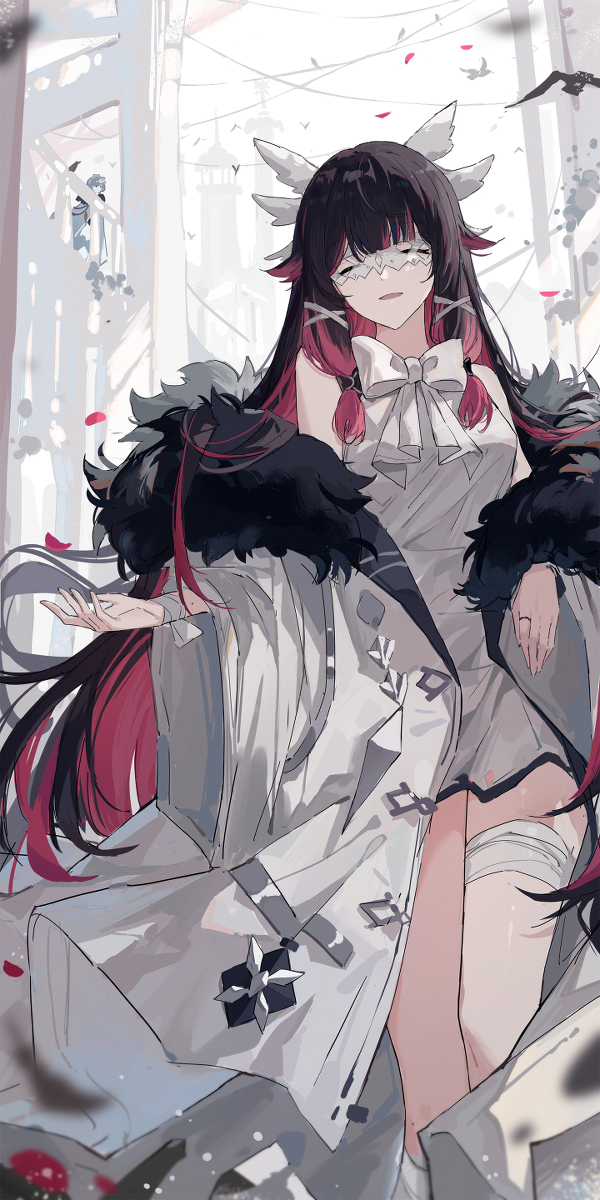
She could see inside the sleigh through the lace covering her eyes. Or rather, she sensed it: the Tsaritsa sat opposite her, while Sandrone sat beside her with her face turned toward the window.
"You cried during the finale, didn’t you?"
Columbina spoke. Her voice was slow and quiet, like she was not asking a question but commenting on the weather.
"...I wasn’t crying."
"During that song, when it rose at the end. Your shoulders trembled first."
"I said I wasn’t crying."
"You said you were going to check on Pulonia, but you didn’t come back for quite a while. And Pulonia was perfectly fine."
Sandrone turned around. Eyes not yet fully cleared of red glared at Columbina.
"Co-lum-bi-na!"
"Yes?"
"I wasn’t crying!"
"All right."
Columbina answered that way and added nothing else. It was a face that did not believe it in the slightest while saying all right, and Sandrone took her eyes from that face and looked out the window again.
"That theater."
Sandrone spoke while looking out the window. No one had asked; the words simply came out.
"There was a man using a cane. It was terribly designed. The handle was too high, the tip was worn down, and the weight was lopsided."
"So?"
"If I made one, I could make something better than that in half a day."
"Are you going to make him one?"
"...Who said I would make one for him? I only said the design was terrible."
"Who was he? That man."
"I don’t know. I met him in the corridor. Pulonia moved aside for him, and he bowed."
Sandrone fell silent there. Columbina let the words a man using a cane settle into place in her mind.
There was something she had sensed throughout the audition.
One person sat in the darkness beside the stage, and two things circled around him. One was red.
It was the aura of death. She knew because she had felt it several times before, though she did not know why that aura surrounded a single person sitting in the corner of a theater.
The other was not red.
It was cold. It resembled what she always sensed from the person sitting opposite her, though it was only similar, not the same. She did not know why that resemblance faintly lingered around him either.
When the song turned toward the side of the stage, the red around that person briefly faded. It was as though even the red knew where the song was directed.
Columbina also knew that the disciple of Signora smelled of blood at her toes when she danced. It was something she had known for a long time—that girl did not understand pain—so it did not make her curious.
As she left the theater, she looked back toward the side of the stage. She looked not with her eyes but with her face, and as she turned it, she sensed the person in that darkness shrink in slightly.
Sandrone said the man she had met in the corridor used a cane.
Columbina had also sensed the person beside the stage leave and return between the singing and dancing, using the tip of his cane against the floor. Sandrone had met someone in the corridor at around that time, and Columbina’s thoughts reached the conclusion that the person sitting beside the stage and the person who had bowed to Pulonia were the same.
She was curious.
That was rare for Columbina. Over nearly five hundred years of life, curiosity was usually answered by what she sensed, and she did not grow curious about what could not be sensed. But today, what she sensed remained unresolved.
"Sandrone."
"What?"
"What does that man do?"
"I don’t know. He must work at the theater. He was holding a steaming cup."
Columbina kept Sandrone’s words. A steaming cup, a cane, something red, and something cold had gathered around one person, and he was likely somewhere among the lights descending below them now.
The Tsaritsa said nothing.
She had not spoken a single word since boarding the sleigh. Throughout the audition, she had said only one thing—to tell the theater manager to begin—and now she only looked out the window.
Outside the window was the theater receding into the distance. Its round roof was shrinking between the city’s roofs, and one light was lit within that round shape.
The Tsaritsa watched that light.
As she watched, the gloved hand on her knee curled. Five fingers folded inward, stayed that way for the span of one breath, then opened again.
Columbina sensed that hand.
The coldness briefly deepened from that hand before settling again, and that deepened quality was the same kind that had lingered around the person in the theater’s darkness.
The Tsaritsa was not someone she could ask why.
The sleigh climbed the slope. The theater roof became smaller still, and the Tsaritsa’s hand remained open upon her knee.
Columbina clasped both hands before her chest. They were the hands of someone trying not to let go of a curiosity.
Beneath a sky where the moon had not yet risen, the theater’s light was visible one final time before disappearing.

Comments (0)
Please log in to leave a comment. Login or Register