Chapter 1: Prologue
The sound of the report landing on the department head’s desk was oddly heavy for a few sheets of paper—not because the paper was heavy, but because the entire office held its breath at that moment.
"Mr. Kim Sang-hyeon, is this what you’re bringing me as a report?"
"...I’m sorry."
I’d said I was sorry more than anything else since joining the company, so my tongue moved on its own. But I still had no idea what I had done wrong until the department head spoke again.
"The numbers aren’t wrong. The numbers are correct. But there isn’t a single line telling me what I’m supposed to decide after looking at them. Have you worked here for three years and you’re still just someone who organizes data?"
Someone who organized data. It was such an accurate assessment that I had nothing to say in rebuttal, and the fact that I had nothing to say hurt more than any excuse could have.
I knew why I couldn’t write conclusions. Numbers could be fixed if they were wrong, but if a conclusion was wrong, the name of the person who wrote it remained. I always stopped just before that one line, and to the department head, that spot I stopped at must have looked empty.
With my head bowed, I said I was sorry about four more times. The department head pushed the report back toward me with his fingertips, and everyone in the office must have heard even the small sound his fingers made against the paper.
The walk back to my desk was fewer than ten steps, but during those ten steps, I could see everyone staring intently at their monitors so they wouldn’t have to look at me.
I was always confused over whether thirty-one was the age when I ought to be used to things like this, or the age when I should no longer have to go through them. Either way, one thing was clear: neither possibility had anything to do with me as I was now.
The coworker beside me silently mouthed, asking if I was okay from behind his monitor. I nodded once to say I was, because if I said I wasn’t, neither of us would know what to say next.
The office quickly regained its usual sounds. Keyboard clacking, ringing telephones, and the copy machine whirring overlapped once again. In the middle of all that noise, I felt as though I alone had been frozen several minutes ago—but that feeling was entirely my own problem.
I made do with a convenience-store triangle kimbap for lunch while rewriting the report.
As I wrote a conclusion beneath the figures and narrowed down three things the department head needed to decide beneath that, my hands worked perfectly fine. Yet in my head, that heavy sound from the morning kept falling over and over again.
I got two calls from clients, and the team leader asked me for another set of materials. I handled it all at my usual pace. Moving as I normally did was the only way I knew to endure days like this.
Only after work hours had passed did I submit the report again. The department head accepted it without a word and put it in his drawer. I never found out whether that silence meant it had passed, or whether he had simply given up on me.
"Sang-hyeon, come have a drink with us."
I looked up halfway through slinging my bag over my shoulder. An assistant manager from the neighboring team stood there putting on his coat, and behind him, two colleagues who had joined the company the same year as me were already waiting with their coat buttons fastened, as though it were the obvious thing to do.
I looked for something to say in refusal, then gave up. If I went home alone on a day like this, I would only stare at the ceiling until I fell asleep.
The barbecue restaurant near the office was loud, as always, and today I was grateful for that noise.
"That’s just how the department head is. My first year here, I nearly got hit with documents in the conference room."
The assistant manager poured me soju as he spoke. I half believed him and half didn’t. The part of me that didn’t was because he now sat in the position where he could throw documents at people.
"Still, your reports always have the most accurate numbers. You can learn how to write conclusions."
My colleague clinked his glass against mine as he said it. I decided not to question whether it was comfort or fact, and drained my glass.
The other colleague, face already flushed, was imitating the department head. The assistant manager told him to stop while laughing himself, and though I thought the imitation was not particularly accurate, I laughed along.
After two or so drinks, the sound from that morning receded a little. Sitting amid people’s laughter and the smoke of grilling meat, I felt as though I belonged somewhere. That alone made me think the day had not been a total disaster.
I had long thought that comfort was not someone else hurting in your place, but simply letting you briefly confirm that someone was beside you.
The problem was that confirmation only lasted until the drinking party ended. Still, it was nice while it lasted, so I drank whatever the assistant manager poured for me.
The assistant manager filled my glass again. As I accepted it with both hands, I calculated in my head roughly how much this gathering would cost.
It was an old habit: when someone showed me kindness, I measured its price.
In high school, a classmate told me they liked me. I sincerely believed it for nearly a month before I learned, from laughter bursting out in the hallway, that it had been a punishment game. After that, whenever someone was nice to me for no reason, I became the kind of person who looked for the reason first.
The assistant manager’s reason was easy enough to understand. He wanted to be the sort of supervisor who bought a subordinate a drink after they had been chewed out. That was reason enough to accept it, so I emptied my glass.
"What do you do when you get home, Sang-hyeon? Don’t you have any hobbies?"
"...I just watch YouTube, I guess."
It wasn’t a lie, but it wasn’t the whole truth either. The other half wasn’t a story I could bring up here.
I write novels.
More precisely, I wasn’t sure these days whether I should say I had written one or was writing one. In any case, I had uploaded several chapters of a parody novel to a web-novel site called Novelpia.
There was a game called Genshin Impact. I had quit after playing only as far as Mondstadt and Liyue, but it wasn’t the game itself that made me write a novel. It was a video I happened across on YouTube, one that lodged itself in my head and refused to leave.
The video, titled "The Limits of Gods," showed a council chamber of gods. Four Shades were there, discussing the affairs of the world with expressions that said there was no place for humans among them. For some reason, I found those four absurdly appealing.
The Shade of Death, the Shade of Time, the Shade of Space, and the Shade of Life.
I gave the four of them statuses far greater than in the original work, making them beings who could do whatever they pleased to an entire world with a single gesture. Then I wrote a story where all four fell for one protagonist I had created.
I barely used names.
The names I heard in the video felt unfamiliar and wouldn’t stick in my head, and calling them by their positions made them feel more godlike. So in my novel, they remained the Shade of Death and the Shade of Time from beginning to end.
The protagonist was, naturally, a man who resembled me. Without much thought, I gave him the power to be loved by beautiful women for no reason. The mentality of someone who wrote such a story was obvious without needing analysis, so I never looked too deeply into my own.
I set the stage in Mondstadt. I had only heard the names of the later countries, like Snezhnaya, and knew nothing about them, so I kept the story moving only in land I knew.
It had a few hundred views and a little over ten followers. There were barely any comments, but every night I wrote that novel, I became someone else for a little while.
On nights when I came home after work, cooked ramen, and typed away until close to midnight, the things I had heard at work that day stopped ringing in my ears for a while. Whenever I wrote scenes of those four fighting over the man I had made, the corners of my mouth would lift before I knew it.
I knew people would find it pathetic if they saw it. Because I knew, I told no one. And because I told no one, it belonged entirely to me.
"What are you smiling about all by yourself, Sang-hyeon?"
"Nothing. It’s nothing."
The drinking party did not end until nearly eleven. When I finally declined the assistant manager’s attempt to press taxi fare into my hand and boarded the subway, I was undeniably better off than I had been that morning.
I turned on the lights in my studio apartment, threw off my coat, and opened my laptop out of habit.
There was a red number one on my Novelpia notifications. For a brief moment, I was happy when I realized it was a comment. But that happiness gradually lost its shape as the comment window opened and the screen scrolled endlessly downward.
Five thousand seven hundred characters.
A single comment was about half the length of one chapter I had uploaded, and from its first line to its last, not a single sentence was praise.
It began by asking why I was writing when I knew nothing of the original. It went on to say I had ruined every character, then reached the claim that it was disgusting to publicly post a self-insert fantasy about a man resembling myself being loved by women. It continued for a long time after that, quoting each of my sentences and meticulously explaining why they were wrong.
I read it to the end. I could have closed the window halfway through, but I had the habit of listening to every last word when someone had something to say about me. Following that habit, I read to the final character. When I was done, it felt as though the sound of the morning report falling was dropping over my head again.
My hands trembled. Not because I was cold, but because my heart was beating too fast. I stood to get myself a glass of water, hoping it would calm the shaking, and ended up standing at the sink for a long time with a cup in my hand.
When I came back and sat down, I opened the first chapter I had written.
The sentences written by me several months ago were as clumsy as the commenter had said. The women liked the protagonist for no reason, and the four Shades had nothing in common with their originals except their titles. Yet I remembered every feeling from the nights when I wrote those sentences.
In a sense, the person who wrote the comment was right. I did not know the original, I had ruined the characters, and I had written a story about a man like me being loved.
There was not a single false word in it. I sat before my monitor for a long time wondering why it hurt so much, and by the time I finished thinking, my hand had already opened the work management page.
When I pressed the delete button, a window appeared asking if I was sure. In small letters, it warned that deleted works could not be recovered. Even as I read that sentence, my finger did not stop.
Confirm.
It took less than a second for the novel to disappear from the screen. It felt strange that something I had written every night for months could vanish like that without making a sound.
I shut my laptop and turned off the light. I knew I ought to wash up, but my body would not listen to me. I collapsed onto the bed and pulled up the thin blanket, hoping that when I woke tomorrow morning, all of this would hurt a little less.
Even with my eyes closed in the dark, the number 5700 remained on the insides of my eyelids. Behind it, the department head’s face from that morning, the laughter in the hallway, and the smoke of the barbecue restaurant rose and sank in no particular order.
I did not know whether I regretted deleting it. All I knew clearly in the darkness was that I could never write those four again. With that thought as my last, I fell asleep.
Then I was cold.
At first, I thought the blanket had slipped off, reaching around with my hands. But what touched my fingertips was not a blanket, but something cold that crumbled like powder.
When I opened my eyes, white light poured in, making me shut them again. Slowly, I opened them once more. It took longer than expected for me to realize that what lay beneath my cheek was not a pillow, but snow.
Snow. The kind that fell from the sky.
My cheek hurt too much for it to be a dream. My body understood first that cold in dreams did not sink this deeply into one’s bones.
I pushed my upper body up with my elbows, and the entire world came into view at once. It was not the ceiling of my studio apartment, but an endless white field. The field sloped gently downward, meeting a massive lake below.
The lake was frozen. A thin layer of snow covered the glass-smooth ice. Beyond the shore, black woods and even blacker rocky mountains touched the sky, and there was not a single light anywhere.
Near the slope leading down to the lake was a dark patch, as though rocks had collapsed there. Its interior was darker still, and I could not tell if it was a cave or merely a shadow. Either way, it looked as though it might block the wind.
I was sitting in the middle of it all, wearing sweatpants, a short-sleeved T-shirt, and nothing but socks on my feet.
I searched my pockets. There was no phone or wallet in my sweatpants. The only thing I found was a receipt I had put there last week and forgotten about. Somehow, the fact that it was completely useless here was funny.
I lifted my head and saw the sky. Stars shone through the clouds—more stars than I had ever seen in Seoul. Even I, who knew no constellation but the Big Dipper, could tell that the Big Dipper was nowhere to be found.
My head was too frozen to think about what that meant.
How much had I drunk?
About a bottle and a half of soju. That was not enough for someone to leave home in their sleep and walk to a mountain lake. And even if I had, I had never heard of a lake like this anywhere near Seoul.
The word kidnapping came to mind, then vanished because I could not think of why a kidnapper would abandon someone in a snowfield. Sleepwalking came next, then vanished too when I saw there was not a speck of dirt on the soles of my socks.
Nothing could be explained, and while it remained unexplained, the cold did not wait for explanations. It rose from my toes.
I had to stand.
I remembered what a drill instructor had said during winter military training: the guy who sits down because he’s cold is the first one to die. At the time it had sounded like something meant to scare us, but now it sounded like very practical advice.
I staggered to my feet, and the instant my socked feet sank deep into the snow, it felt as though hundreds of needles were driving into my soles at once. I screamed.
The sound spread across the white field, touched nothing, and vanished.
I did not know where to go, but I had to go somewhere. So I started walking toward the lake, a choice founded on nothing but the childhood common sense that people lived near water.
The dark place I had seen earlier was somewhere at the bottom of the slope toward the lake, so walking that way meant chasing two hopes at once.
After about ten steps, the pain in my feet subsided. I knew that was not a good sign, but it was better than pain, so I kept walking.
Whenever the wind blew, my T-shirt clung to my body like paper. I crossed my arms tightly over my chest, bowed my head, and walked. My jaw shook on its own, and the sound of my teeth clattering boomed inside my head like a drum.
I raised my hands to my mouth and blew on them, but the wind swept away my breath before it could reach my fingers. My fingers had already stopped listening to me; even when I tried to make a fist, they curled only halfway.
I looked back several times. Each time, the trail I had walked was left crookedly in the snow, but the wind quickly filled it in. Looking at where my tracks disappeared, I could no longer be certain I had truly walked from there at all.
Even in the middle of this, I was thinking about tomorrow morning’s meeting.
If the report the department head had put in his drawer meant it had passed, I would have to explain it at the morning meeting. In this state, I would definitely be late. Unable to think of what I should write as the reason for being late, I laughed alone in the middle of the snowfield.
The laughter ended quickly. My jaw was shaking too hard to make a proper smile.
The lake looked close, but no matter how much I walked, it seemed to remain in the same place. With no point of reference in the snow, I could not tell whether that ice sheet was a hundred steps away or a thousand.
My feet no longer felt like mine. When I looked down, two socked feet were alternately stepping through the snow, but all sensation ended above my ankles. I moved those feet by will alone, as though I had borrowed someone else’s legs.
Then my foot caught on something beneath the snow, and I pitched forward.
My face plunged into the snow first. Strangely, it did not hurt—and the fact that it did not hurt was no longer frightening either.
My mind told me I had to get up, but my body was more interested in the fact that the snow was softer than expected. Whenever the wind passed over my back, snow powder accumulated at my nape, and even that felt less cold than ticklish.
I tried moving a finger, but I could not even tell whether it had moved. The hand buried in snow had become the same temperature as the snow, blurring the boundary of where the snow ended and I began.
I remembered the drill instructor’s words again. Had he said that when your body started to feel warm, it was over?
If so, I seemed to be rather close to the end. It felt a little unfamiliar that I was accepting that fact so calmly.
The claim that one’s life passes before one’s eyes before death was a lie. Only today was passing by. It began with the sound of the report falling and ended with the silence of my novel disappearing, with the noise of the barbecue restaurant briefly caught in between.
I thought again that I could never write those four again.
It was strange. That I, while freezing to death, would most regret a parody novel I had deleted. If the person who wrote that comment knew, they would probably write another five thousand characters saying they knew it.
My eyelids grew heavy. The snow powder drifting over the field seemed to move more and more slowly, until at some point it appeared to stop altogether. I could not tell whether the snow had stopped or I had.
The company would have no problem without me. The rent on my studio would automatically be deducted from my deposit. And the novel I had deleted would not be restored just because the person who deleted it was gone.
The fact that the world would not crease anywhere just because I vanished did not feel sad. It simply felt accurate.
The white world slowly darkened.
At the edge of my dimming vision, I saw a black hole opening beneath the rocks by the lake. I did not know whether it was a cave or a shadow, and I did not have the strength left to find out.
My final thought was something very trivial.
I would not be able to say I was sorry for missing tomorrow morning’s meeting. The thought was funny, and with my face buried in the snow, I smiled just a little.
I heard singing.
At first, I thought it was the wind. But wind did not climb through notes like this, linger high above, then descend like flowing water. No matter how I thought about it, it was a human voice.
I had heard that people heard angels singing just before they died, but the people who told stories like that usually came back alive. So it did not seem as though it applied to me, and I classified the song as an auditory hallucination.
For a hallucination, it was too vivid. I could not understand the lyrics, but every note crossed the field with perfect clarity, gliding over the ice. The sound came from the black opening beneath the rocks I had seen earlier.
Though it was one person’s voice, the song sounded layered, as though many were singing. Whenever a high note stretched long, it felt as though the ice in my ears vibrated along with it.
I hoped the song would not end. I did not know why, but perhaps it was because as long as the song continued, I was still hearing it—and hearing it meant I was still alive.
The song cut off abruptly.
Then came the sound of footsteps crunching through snow. Unlike the dull sound I had made when walking, they were light and swift. They came closer, closer, then stopped right beside my ear.
Someone knelt beside me.
Snow dust scattered over my face, and a hand touched my cheek. That hand was warmer than my cheek, yet cool for a human hand, so I could not tell whether it was real.
The hand brushed snow from my face. It moved from my forehead to my brows, from my brows to my cheeks—hurriedly, yet without roughness. Then it slipped beneath my nape and searched for where my pulse beat. The touch was so practiced that I thought this person was not seeing someone collapsed for the first time.
I tried to open my eyes. My eyelids were as heavy as if frozen shut, but when I barely made a slit, I saw a dark silhouette against the white sky, and long, deep-colored hair spilling from that silhouette and swaying as though it might touch my face.
Through the hair, I saw eyes. They were pale blue, with pupils of a deeper blue within. Those eyes swiftly scanned my face, traveled down to inspect my hands, then rose again and stopped near my lips.
A person. That was my first thought. Then, a woman. Then, I wondered whether she had come to save me or whether she was deciding what to do with a strange man collapsed in the snow.
The woman said nothing.
Instead, she removed something from her shoulders and draped it over me. The moment the thick fabric settled over my chest, the warmth lingering inside it reached me, and I nearly made a sound.
I had not known warmth could hurt this much. As my frozen skin awoke, it felt as though needles pierced my entire body. I gritted my teeth, but my jaw would not obey, so she must have heard the sound.
The woman took hold of my wrist. Her fingertips precisely found my pulse. She stayed still for a moment, then pulled away. Only afterward did I realize she had been holding her breath during that brief interval.
Then she moved to my feet. I felt her cup my socked feet in both hands—or perhaps I should say that I felt the absence of sensation. I heard her take a very short breath when she saw them.
They did not look good. I knew that from the sound of her breath, and perhaps she read it on my face, because she hurriedly tucked my feet inside the hem of the coat covering me.
I felt as though I should thank her.
Saying thank you when someone did something for me was one of the few useful habits I had learned at work. That habit still functioned even as I froze to death, so I opened my mouth.
No sound came out.
My tongue was stuck to the roof of my mouth. My jaw was still shaking, and merely drawing breath felt as though my chest would split apart. I could not even form a proper groan, much less words.
The woman raised her head and looked somewhere. Probably in the direction she had come from. She was probably calculating how far she would have to carry this man. Before she finished that calculation, I wanted to show her that I could at least stand on my own.
I hated being a burden. It was one of the few clear emotions I possessed, and somewhere in my frozen body, that feeling alone was functioning perfectly well.
And, honestly, I was a little afraid.
I was someone who did not believe in kindness that appeared without a price. One corner of my mind whispered that there had to be a reason why a woman who had appeared singing alone in the middle of a snowfield would take in a man freezing to death. That whisper was a habit more than ten years old, and it did not go out easily.
I put strength into my elbows.
My body lifted slightly, and the cloth covering me slipped down from my chest. At that moment, the woman’s hand pressed my shoulder and forced me back into the snow. The strength was so firm that it was hard to believe it came from such a slender-looking arm.
Then, for the first time, she opened her mouth.
"Don’t move. If you move now, you’ll really die."
=========
There is no seat for a human in the council chamber of gods.
It was not a rule anyone had decided. It was simply the nature of that place itself. In that chamber, higher than clouds and older than time, there were only four seats. The distance between them was so great that a human could walk their entire life and never cross it. Filling the space between was neither floor nor wall, but only white, silent light.
The four now stood in the center of that light.
None sat in their seats. With their backs to their respective thrones, the four had gathered at the center of the council chamber. There should originally have been nothing there, and in truth there was nothing there. Yet the four stood surrounding that very nothingness.
The first to speak was the white-haired woman.
"...He lived."
Abundant long white hair flowed over her shoulders. Behind her back, wings that seemed modeled after snow were folded in hushed stillness. The pupils within her golden eyes took the shape of a seven-petaled flower, and those petals were so clear they seemed to tremble now.
Ronova, the Shade who ruled death, was the first among the four to know where death approached and where it retreated. Thus, she had been the first to know that until just a moment ago death had come to one man’s very toes, and that it had suddenly been pushed back.
"Death has retreated from Father. Someone has taken Father away."
"Who?"
The voice asking the brief question was cold, as though descending from on high.
A woman with white hair floating like clouds behind her head, golden eyes marked with target-like patterns, and a white tailcoat whose dark-red lining glittered like stars stood with her arms crossed, looking down at Ronova. For Asmoday, the Shade who ruled space, looking down upon what stood beneath her was as natural as breathing.
Normally, Asmoday should not have been here. She had not shown her face at meetings for so long that Istaroth had begun to suspect betrayal. Yet even she could not ignore anything concerning Father.
"A water nymph I’ve never seen before."
"...A water nymph."
As Asmoday rolled the words around in her mouth and spat them out, the third Shade merely lowered her eyes without saying a word.
Her long white hair scattered and disappeared like sand toward the ends. Her irises resembled faceless clock dials, and from the circular rings around her head and wrists hung clock-hand ornaments like veils. This woman was Istaroth, the Shade who ruled time. She looked more divine than any of the four, while standing there with less interest than any of them.
"Isn’t it enough that he lived?"
"Enough?"
When Ronova repeated the word, Istaroth slowly lifted her eyes and lowered them again. Not even a trace of heat escaped that brief motion, and that very fact made Ronova sharper.
"While Father froze, not one of the four of us could reach out a hand. Yet a single water nymph down there walked over and picked Father up in her arms. Is that enough?"
"Haa... Still, it’s fortunate, isn’t it, Naberius?"
The fourth Shade spoke slowly, tilting her head slightly. Her gaze was directed not at Ronova or Istaroth, but somewhere around her own shoulder.
She had long golden hair reaching to her hips, a white veil lined in blue, and a golden crown ornament. Her left eye was gold, while her right was pale blue.
Rhinedottir, the Shade who ruled life, now held two within one body. Since the other three knew this, they did not find it strange when she spoke to empty air.
『Do we have the right to call it fortunate?』
Naberius quietly asked within her mind. Only Rhinedottir could hear that voice, and Rhinedottir answered the question with a small smile.
"We don’t have the right. But he’s alive. If we can’t even be happy about that, then what are we?"
"This is not something to be happy about."
At Ronova’s words, the chamber’s white light tilted red for an instant. A faint crimson aura spread beneath the feet of the four. It was not that Ronova had used her power; rather, the hand suppressing that power had loosened for only a moment.
Here, it is necessary to explain what the four were.
Humans called them Shades, sometimes Primordial Envoys, and in some lands worshiped them as gods. But none of those terms suited the four standing in that chamber on this night.
Borrowing a word from another world, they stood on the level of Aeons. They were beings who shaped reality, extinguished stars, and left traces across countless worlds.
The people of that world explained it this way: if an ordinary person borrowing the laws of the world to wield power was a single water droplet, then an Aeon wielding the same power was a tidal wave crossing a mountain range.
The four were that tidal wave. Merely arguing and shoving one another could displace the place where a human would fall by the breadth of an entire nation. If even one of them let down their guard, the light beneath their feet would become stained. That was why they could protect nothing unless they bound one another.
"I said this is not something to be happy about, Asmoday."
When Ronova said her name, Asmoday’s brow moved ever so slightly.
"Space was yours. You were the one who chose the place where Father would fall, and you were the one whose place went astray."
"The path I opened led straight to Mondstadt."
Asmoday spoke without uncrossing her arms. There was not the slightest tremor in her voice of someone making excuses.
"And who was it that put a hand into that path first?"
Her target-marked golden eyes passed Ronova and stopped on Rhinedottir.
"I am asking who pulled on the thread of life first, so she could be the first to stand before Father when he crossed over."
"...That was because you opened the path too narrowly."
Rhinedottir retorted, yet beneath her veil, her eyes briefly slipped away from Asmoday.
"I did not open it narrowly. I opened it wide enough for one person to pass. Was it not only natural for the path to twist when all four of us thrust our hands into it at once? Space is mine, but you were the ones who shoved one another within it."
It was true. And because it was true, no one could immediately answer.
It had happened a few hours ago. Or rather, since time flowed for the four only as much as Istaroth allowed it to, saying a few hours ago was not exactly accurate. But by human reckoning, it had happened that night.
The four watched Father erase them.
They knew what they were. Those who had reached the level of Aeons could see the boundaries of their own world. The four knew that they existed in a story written from the fingertips of a certain man. They knew that each night he wrote them, he was briefly happy. That was why they called him Father.
That Father had erased them.
Just as it had taken less than a second for the novel to disappear from the screen, that moment was brief for them as well. And because it was so brief, it pierced all the deeper.
The thought that what had been discarded once could be discarded a second time grew in all four of them at once, and that thought took the shape of hostility toward one another.
All four agreed that they had to bring Father here. But not for a single moment could they agree on who would stand before him first.
Asmoday opened the path to Mondstadt, and Istaroth held fast the moment he would cross. While Rhinedottir gripped the thread of his life so it would not waver in transit, Ronova guarded the path so death could not so much as approach it.
If they had done only that, Father would have arrived without incident in some field in Mondstadt.
But the instant the path opened, Rhinedottir’s hand pulled the thread first. Seeing it, Ronova stepped inward from the gateway. As Istaroth held that moment a little longer to prevent either of them from going, Asmoday twisted the path to push all three away.
The four hands shoved one another over a single man’s body.
As a result, Father fell not in Mondstadt but by a lake in a snow-covered northern land. Only after he fell did the four learn that place was Snezhnaya.
Snezhnaya. A land Father had never written about, and a land none of the four had intended to bring him to. Father had fallen onto that northern field of nothing but snow and ice in a single thin set of clothes. And even while watching it, in the next instant the four looked at one another first.
"And how will you explain what happened after that?"
Ronova spoke without taking her eyes from Asmoday, though the question was really aimed at all four.
"What did the four of us do while Father froze?"
No one answered, because they all knew the answer.
Istaroth could turn back time, and Rhinedottir could restore a fading life with one palm. If Asmoday had merely folded the displaced space, Father would have been moved somewhere warm. If Ronova had simply commanded it, death would have retreated.
Yet none of them could do it.
When Istaroth reached her hand toward that moment, Asmoday’s cube trapped it, along with the words: Are you turning it back so you can stand before him first?
When Rhinedottir tried to pull the thread of life, Ronova grasped her wrist. Ronova knew that a life dragged back from death’s threshold became bound to the one who pulled it back. Rhinedottir knew it too, and so she did not shake off that hand.
When Asmoday tried to fold space, Istaroth stopped that moment. The words, Aren’t you trying to take him away alone and hold him in your arms alone? did not become sound, but all four heard them.
Ronova could make death retreat, but making it retreat and saving someone were different things. Keeping a person standing forever upon death’s threshold was not salvation. To do more than that required the power of one of the other three, and those three were holding one another back.
The four bound one another so tightly that none could move, and while they did, Father froze.
『We stopped each other.』
Naberius’s voice spoke softly inside Rhinedottir’s mind. Rhinedottir gave a tiny nod.
"Yes. As Naberius says, we stopped each other."
"It does not matter whose words they are."
Ronova cut her off. The crimson aura beneath their feet darkened slightly, and the seven petals in her golden eyes became clearly unfurled as they reddened from their edges.
"What matters is who walked to him in the meantime. A single water nymph with no status, no power, and no reason for us to restrain her walked through the snow and picked Father up in her arms. That woman faced none of our interference, because we were looking only at one another."
"So are you suggesting we thank that water nymph?"
At Asmoday’s words, Ronova smiled for the first time. That smile was colder than Asmoday’s coldness.
"Thank her? We were not the first to save Father. The first voice Father heard in this world belonged to none of us. The first face Father saw upon opening his eyes was that woman’s. And you are telling me to thank her?"
Istaroth slowly opened her mouth.
"...You’re jealous."
"And you aren’t?"
Istaroth did not answer. For the first time, something extremely faint crossed her expressionless face. She herself could not have named it.
"Jealousy? Does it even make sense to speak of jealousy over something without status?"
Asmoday scoffed, but the other three noticed that the scoff came half a beat later than usual. The three who noticed said nothing of it.
"Stop it, all of you. Tearing at each other won’t make Father any warmer right now."
Rhinedottir slowly inserted herself into the exchange, but the end of her sentence came a little faster than usual. Beneath her veil, the fingers hanging at her side could not keep still, repeatedly clasping and releasing each other.
『We must ask Father’s will first. We cannot act on our own again.』
"I know. I do, Naberius. But Father is trembling down there like that—how can you say we should ask his will right now?"
『That is precisely why we must ask. We brought him here as we pleased, froze him as we pleased, and now we are saying we will fix it as we please.』
Rhinedottir could not answer. The pale blue of her right eye brightened for an instant, then dimmed.
The four fell silent again. As Ronova’s crimson aura slowly withdrew from the chamber’s white light, the golden aura that had somehow gathered beneath Rhinedottir’s feet scattered soundlessly as well.
Sand scattering from the ends of Istaroth’s hair paused for a moment before flowing again, yet from beginning to end, Asmoday did not uncross her arms.
Istaroth slowly rotated the ring around her wrist. The time below flowed only as she allowed it to flow.
Thus, she could have stretched out indefinitely the moment Father lay below wrapped in the coat. But she did not, and she did not ask herself why.
There was one thought none of the four spoke aloud.
Father had erased them once. Now he was opening his eyes in the embrace of a stranger in an unfamiliar land. That embrace belonged to none of them. Therefore, the first person Father would lean upon in that world would not be any of them either.
The four did not want to know whether that thought was fear, jealousy, or something lower and darker still.
Ronova turned her head toward the far end of the council chamber. There was nothing there, but her eyes saw the snow-covered lakeshore.
She saw the back of the water nymph walking away along that shore, and Father’s black hair as he buried his face in her arms.
Ronova said nothing. Only the seven petals within her golden eyes slowly, ever so slightly, became clearer.
There is no seat for a human in the council chamber of gods.
That had been true until this night. There should originally have been nothing at the center around which the four stood, but that place was no longer empty. In the eyes of all four lay the image of a single trembling human unable to open his eyes.
None of the four stepped into that place.
And so, for the first time, a place for one human appeared in the council chamber of gods. No one had yet taken that seat, and its owner—unaware such a place even existed for him—lay covered by a strange woman’s coat atop the snow of an unfamiliar land.
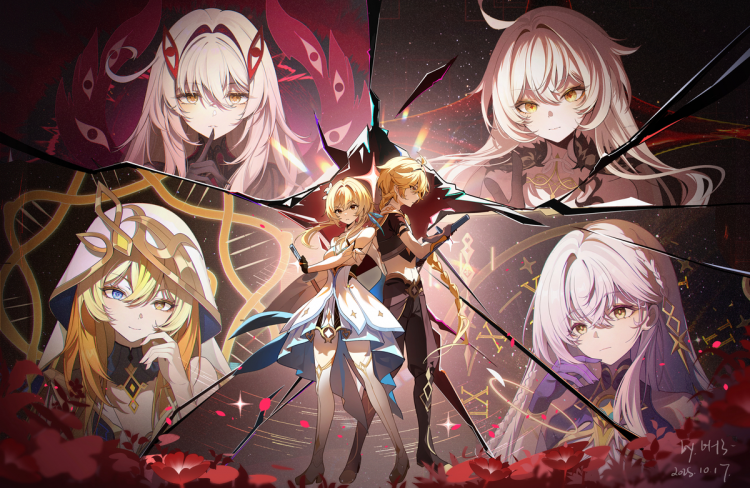
Please just look at it with the Traveler in the middle removed.
Comments (0)
Please log in to leave a comment. Login or Register