Chapter 60: Rhea's Milk (Illustration Added)
Hephaestus spoke in a grave voice, holding a single bone in his hand.
At his incomprehensible statement, a deep sense of bewilderment began to rise among the gods.
"Um... Hephaestus? What exactly do you mean by that?"
"A splendid offering...? What are we supposed to do with lumps of tasteless fat and hard bones like these? Are you insulting us?"
Athena spoke cautiously, her voice filled with curiosity,
while Poseidon questioned him in a prickly tone.
Without a word, Hephaestus picked up a fragment of bone small enough to fit in his palm from the pile before him.
Then—
Crunch!!
"Huh?"
"Ugh!?"
In the next instant, Hephaestus began to squeeze it hard in his grip.
Crack! Craaaunch!!!!
Blazing heat rose from his fist, accompanied by an awful sound that should not have been possible—a chilling noise as though not a fist, but tectonic plates themselves, were colliding and grinding against one another.
Even Poseidon fell silent for a moment at the overwhelming force of the sight before him.
Then—
Fwoooosh.
After that brief moment of only a few seconds, which somehow felt like hours, came to an end,
Hephaestus opened the fist he had clenched so tightly.
What appeared within it was—
a tiny gemstone, no larger than a tear, glittering in his palm.
It was something made by melting and compressing bone, similar to what later generations would call a “memorial jewel.”
By forcibly combining the carbon and other components within the bone through grip strength... divine power, he had created it, and it had been finely fashioned to shine with a brilliant radiance.
The sight shut the mouths of the gods who had just been raging over what use such bones could possibly have.
"What? How did you do that?"
"W-wha... what the nymph is that!?"
As only the nymphs’ astonished voices could be heard,
Hephaestus spoke in a calm voice.
"Everything has a way it can be used. Whether something has value or not simply depends on whether you know how to use it."
"Ahem..."
"Well, that is not wrong."
At Hephaestus’s words, Hades, who had been watching the situation with interest, added a remark of his own.
The mood softened somewhat after that.
Then Hephaestus immediately addressed the gods gathered there.
"Now then, since such an abundance of offerings has been brought forth, I will show you further uses for them."
Hephaestus gave a casual tilt of his chin as he spoke.
Immediately, Thetis and Keres, who were seated nearby, as well as Ares, who had been sitting right beside Zeus, all rose to their feet.
At Hephaestus’s instruction, the three began gathering and cutting the bones.
With them bustling about so busily, the gods could only watch in silence.
Then—
"Um... is there anything I can help with?"
Athena cautiously approached, furtively gauging the room’s mood.
Hephaestus answered in a serious voice.
"Are you strong?"
"Pardon? Ah... yes. Of course. I may look like this, but I am the goddess of war."
"Good. Go bring a large pot. Fill it with water."
"Understood!"
Smiling brightly, Athena immediately ran toward the kitchen.
Watching her, Thetis, who was sorting the bones, frowned slightly.
Surely he has not added another one in the meantime... has he?
As yet another small seed of disaster was planted, something steadily began to take shape.
On one side, the young gods divided and cut the bones,
while the prepared bones were transformed into something amid the flames Hephaestus had created.
It gave off a savory scent that made mouths water.
The hearts of the gods, who had initially watched with indifferent eyes, gradually filled with anticipation and curiosity.
And after a while—
"C-careful carrying it!"
"I-it smells delicious!"
"For some reason, my heart is pounding!"
The dishes were set upon the table alongside bread made from grain the nymphs had brought.
One was something resembling a pure white stew, made by simmering bones in a pot until tender and seasoning it with salt.
The other was made by cutting bones crosswise into round slices and roasting them directly over hot flames.
They had never seen anything like either dish, but the fragrance drifting from them alone was extraordinary.
Hephaestus spoke calmly.
"These are offerings the humans have presented to us. Eat."
"Hmm..."
"Well, since we have the chance..."
It was food they had never seen in their lives.
As the gods showed a mixture of wariness and curiosity,
one person who had been watching everything particularly closely until now stepped forward.
Hestia was the first to take some.
"You said we should dip bread into what is inside the bone?"
"That is correct, Hestia."
The eldest and firstborn daughter among the gods.
As the goddess of the hearth, she took greater interest in cooking than anyone. With deep anticipation, Hestia dipped bread into the black substance at the center of the roasted bone and cautiously placed it in her mouth.
And then...
"It is delicious!"
"Hm?"
"S-sister? Is it really that good?"
Hestia let out a cry that was nearly an exclamation.
Demeter, who had been watching for a cue, put some in her mouth as well.
Then...
"N-no, how can this... How can there be such sweet butter inside such a hard bone...?"
"By Gaia’s breasts..."
The gods voiced their admiration and astonishment.
Starting with Hestia, their hands naturally reached next for the pure white stew placed to one side.
The flavor of the first dish had surpassed all expectations, so the gods drank the stew with equal anticipation.
In the next instant—
W-what... is this flavor?
They felt a smooth, profoundly savory taste that warmed their bodies from within.
It was deep and rich, as though it embraced the very origin of their souls, while somehow soothing a corner of their hearts. The flavor brought a pleasant tranquility to the gods, whose hearts had been brimming with excitement over the unfamiliar taste of bone butter.
For Hestia in particular, who possessed the finest palate among the gods, that tranquility felt even stronger and deeper.
At the same time, the image of someone she had long forgotten began to surface in her mind...
The image of that person, whom she suddenly missed so desperately.
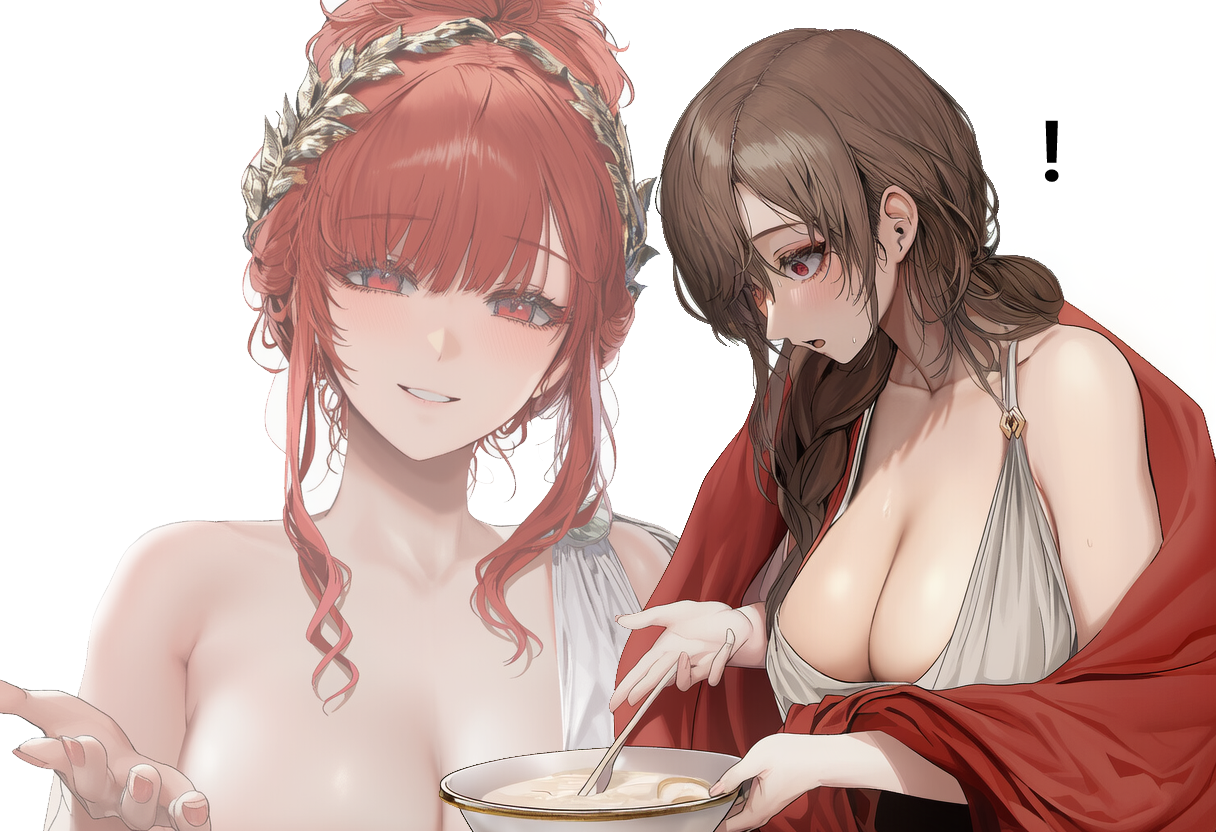
Mother...?
It was only a mouthful of stew made by boiling bones.
Yet moved deeply by the warmth of that person she seemed to feel so clearly within it,
Hestia quietly spoke.
"It truly is... an excellent dish. I feel ashamed that I was complaining just moments ago about receiving such a strange offering."
Hestia spoke with complete sincerity.
Then, looking at Hephaestus, she asked in a serious voice,
"I would like to know. What are these dishes called?"
Even she, who ruled over the hearth and could practically be called the goddess of cooking, had never seen a method of cooking like this.
She did not know how he had discovered such things,
but driven by the fundamental desire of a god to know, she wished at least to learn their names.
"For now, I have named this God’s Butter (Bone Marrow)."
Since the inherent domain of cooking belonged to Hestia, Hephaestus spoke with a touch of caution.
And as he said, since it was butter made from bones offered to the gods,
Hestia, too, thought there could be no better name.
"A truly fitting name. Then what is this stew called?"
Though it had been made simply by boiling bones, the pure white stew had delivered a flavor that seemed to seep into their very marrow.
Suppressing one name that came to mind, Hephaestus answered quietly.
"I have not decided on a name yet. Please name it, Hestia."
"Hmm..."
Thinking that it would be rather inappropriate to mention its real name here, Hephaestus smoothly passed the responsibility to her.
After thinking for a moment, Hestia gave her own answer.
"The white broth and the profound nostalgia in its taste, the feeling of it soaking into one’s soul—it is like a mother’s milk. Therefore... I shall name it Rhea’s Milk, after our noble mother."
"Ohhh..."
"Indeed! There could be no name more fitting."
"As expected of you, sister. It is a truly excellent name. We should bring Mother a bowl of it someday as well."
"..."
Thus, “Rhea’s Milk” became the official name for the soup made by simmering cow bones.
Hearing that grandiose name, which seemed rather excessive to someone who knew its real name,
Hephaestus solemnly drained a bowl of Rhea’s Milk.
Meanwhile, one person watched Hephaestus.
The king of the gods, who had been feeling unsettled for some time now.
Within Zeus, an even deeper sense of unease and wariness was growing.
So in the end, that bastard is the one who profited most again... Isn’t this like doing all the work only to hand it over to a dog? And now it has become ambiguous whether we can punish the humans at all...
In the original myth, Zeus, just as he had now, decreed during the division of a sacrificial animal that fat and bones, rather than the meat covered in hide, were to be offered to the gods.
But the Zeus of that time had already half made up his mind to destroy the humans who had stolen fire and were using it as they pleased.
For that, he needed a suitable pretext. Thus, though he understood everything through Metis’s wisdom, Zeus deliberately chose the bones covered in fat.
Having secured the justification of holding humanity accountable for deceiving the gods, Zeus proceeded step by step with his plan to destroy humans, aided by the agreement and cooperation of the other gods.
Not a single god other than Prometheus objected.
In the end, Zeus succeeded in nearly wiping out the human race.
But unlike that Zeus—
at this moment, the man in this world who possessed Metis’s wisdom,
Hephaestus had made an entirely different choice.
The bones and fat could have served perfectly well as grounds to accuse humans of deceiving the gods.
Yet Hephaestus had transformed them into “splendid offerings,” weakening Zeus’s justification for openly cracking down on humanity.
And in the process, humanity’s faith in Hephaestus would inevitably grow even stronger.
Cunning bastard... He looks as though all he can do is use brute strength... How can he possess such wisdom behind a face like that...?
As he struggled to soothe his churning stomach, Zeus drained the Rhea’s Milk set before him.
Even so, he had to admit that this, at least, tasted truly excellent.
Comments (0)
Please log in to leave a comment. Login or Register